
Sommaire
1. Les 5 règles de l’ergonomie physique pour les enfants
2. Apprendre l’ergonomie en s’amusant
3. L’ergonomie et les devoirs à la maison
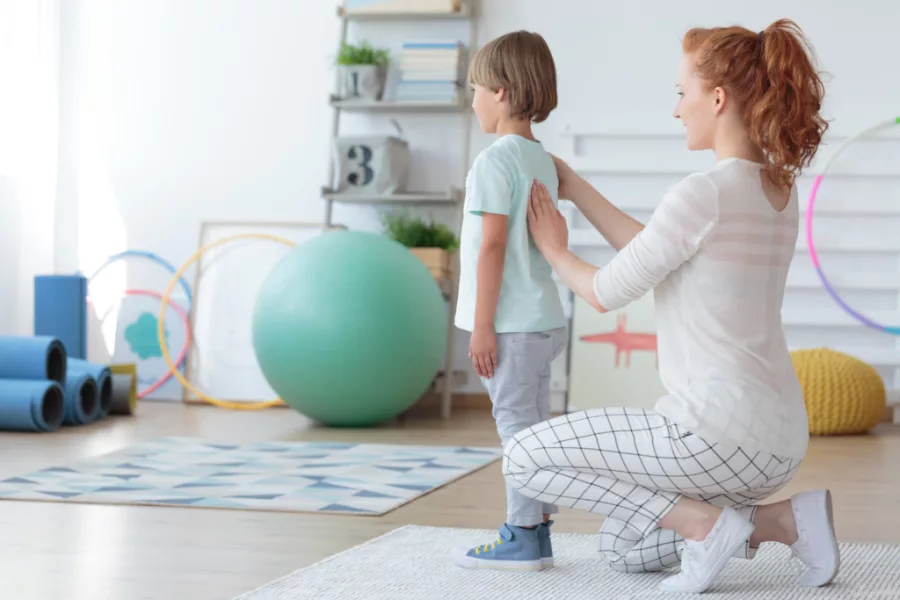
On constate qu’à l’âge de 11 ans seulement, 1 enfant sur 3 souffre de maux de dos. À 14 ans, ils sont déjà 2 sur 3 (1). Ces douleurs (lombaires, dorsales ou cervicales) sont causées, entre autres, par de mauvaises postures, notamment lorsque l’enfant est assis à l’école ou devant un ordinateur : pendant toute sa scolarité, il restera assis 1000 heures par an ! (1).
Peu de parents et d’enseignants ont connaissance des bons gestes à transmettre à l’enfant pour qu’il prenne soin de sa posture et de sa santé. Les douleurs survenues pendant la croissance peuvent entraver les apprentissages à l’école et être une cause d’absentéisme (2). De plus, les mauvaises habitudes prises risquent d’engendrer des pathologies sévères à l’âge adulte.
Heureusement, les enfants ont une grande capacité d’apprentissage : c’est le moment de leur transmettre les bonnes pratiques qui leur permettront de préserver leur santé et de prévenir les risques de pathologies.
Quel discours adopter ?
Il n’y a pas d’âge pour commencer à parler d’ergonomie à votre enfant. Les différentes phases de croissance peuvent occasionner chez lui une grande fatigue et même des courbatures. Il est donc important de le sensibiliser régulièrement, en adaptant votre langage à ses capacités de compréhension tout au long de son développement.
Vous verrez que le quotidien est rempli d’occasions pour transmettre à votre enfant les bases de l’ergonomie physique et que vous pouvez aborder ce sujet de manière ludique. Vous l’aiderez ainsi à prendre conscience de son corps et de ses limites. Cela est d’autant plus bénéfique pour les enfants qui ont des difficultés dans la gestion de leur corps et de leurs émotions. Une discipline comme la psychomotricité peut leur être utile car elle se base sur le lien entre le corps et l’esprit et vise à les accompagner dans leur développement, en les aidant à retrouver une relation harmonieuse avec leur corps et en les remettant en lien avec leurs émotions (2).
Les 5 règles de l’ergonomie physique pour les enfants
Pour sensibiliser votre enfant à l’ergonomie physique, vous pouvez commencer par passer ensemble en revue ses 5 règles de base. Expliquez à votre enfant qu’en faisant les bons mouvements, il se sentira bien dans son corps et sera plus fort.
1. Je m’étire
Tous les matins, pour bien commencer ma journée, je me lève doucement et je prends le temps de m’étirer ! Debout, je tends les bras le plus haut possible vers le ciel.

Pour les parents : Les enfants sont plus souples que les adultes. Ils ont tout intérêt à entretenir cette souplesse pour éviter qu’elle ne se transforme en raideur et engendre des douleurs chez l’adulte. Des étirements réguliers sont un excellent moyen d’y arriver, tout comme le yoga (cf. partie suivante).
Il existe également des étirements plus spécifiques à conseiller. Par exemple, si votre enfant est resté longtemps devant un écran, conseillez-lui d’étirer ses yeux : sans bouger la tête, regarder en haut, en bas, à droite et à gauche. En règle générale, il est conseillé d’éviter une utilisation prolongée des écrans, notamment parce qu’elle peut avoir des conséquences négatives sur les postures : contractions musculaires statiques pour tenir l’appareil, dos voûté, etc.
2. Je me tiens droit
Tout au long de la journée, je veille à garder le plus possible mon dos droit, par exemple quand je me baisse pour ramasser un 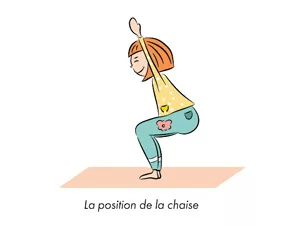 jouet, ou que je suis assis sur ma chaise.
Pour les parents : Proposez à votre enfant de jouer au jeu de la chaise pour s’entraîner à garder le dos bien droit : il doit plier ses genoux et faire comme s’il était assis sur une chaise.
Si c’est trop difficile, il peut se placer contre un mur. Dites-lui de rentrer son nombril le plus possible dans son ventre, de bien coller son dos au mur et comptez ensemble jusqu’à 10 en tenant la position.
3. Je bouge
À quoi joue-t-on aujourd’hui ? Je peux faire la course dans le jardin ou le parc, jouer au ballon, à la corde à sauter, à la marelle, à cache-cache…
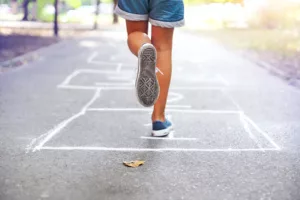
Pour les parents : Il est recommandé aux enfants de pratiquer une activité physique dynamique pendant 1 heure par jour (3). Le week-end, vous pouvez répartir ce temps sur la journée : 30 minutes le matin, 30 minutes l’après-midi par exemple. Pour varier les activités, faites appel à la créativité des enfants !
Vous pouvez également proposer à votre enfant de pratiquer une activité sportive plus encadrée (dans un club ou une association), qui lui apportera des habitudes pour entretenir son corps et une bonne hygiène de vie.
4. Je mange équilibré
Mon corps a besoin de carburant, un peu comme la voiture de papa et maman : pour que le moteur tourne,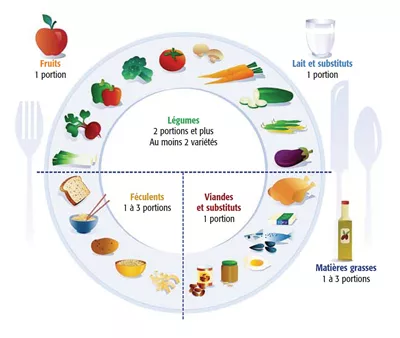 il faut mettre de l’essence ; pour que mes muscles fonctionnent, il me faut de la nourriture ! Alors je goûte de tout et je mange varié pour rester en bonne santé et bien grandir.
Pour les parents : Une alimentation saine doit comprendre 3 repas équilibrés par jour et des collations au besoin. Ci-contre, une assiette type pour votre enfant (4). La taille de l’assiette peut varier en fonction de l’appétit, mais pas les proportions des différents groupes alimentaires.
5. Je bois suffisamment

Je pense à boire de l’eau régulièrement, tout au long de la journée, je n’attends pas d’être assoiffé ! Comme la nourriture, l’eau permet à mon corps tout entier de bien fonctionner.
Pour les parents : Pour que votre enfant boive régulièrement, intégrez cette habitude à ses rituels (au réveil, au goûter, avant le dîner, etc.).
Apprendre l’ergonomie en s’amusant
Pour mettre en pratique les règles ci-dessus avec votre enfant, jouez avec lui ! Voici quelques idées de jeux à pratiquer à la maison pour intégrer les bonnes habitudes ergonomiques en s’amusant.
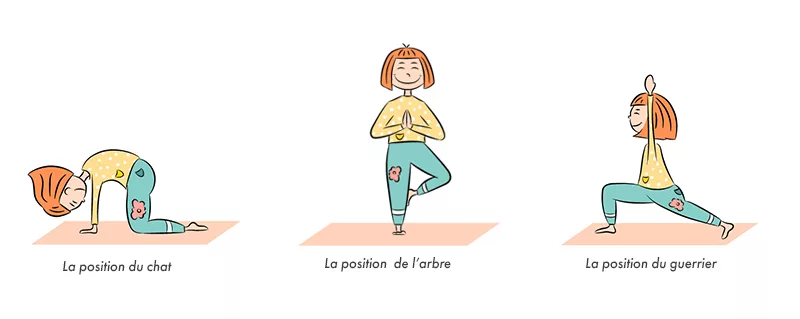
Faire du yoga
Le yoga est une discipline qui permet à votre enfant de découvrir son corps et de mieux gérer ses émotions. En pratiquant régulièrement différentes postures, votre enfant va gagner en souplesse, en force, en concentration et en confiance en lui.
Quelques exemples de postures à faire avec votre enfant :
Jouer au jeu de l’oie de la forme (5)
Séverine Haudebourg propose un jeu de plateau pour faire du sport en famille. Téléchargez ici, lancez le dé et laissez-vous guider ! Autre idée d’activité avec vos enfants : créer votre propre jeu de l’oie avec les mouvements de votre choix… pourquoi pas des postures de yoga ?
Jouer au quotidien !
Le quotidien des enfants offre de nombreuses occasions de pratiquer les bons gestes de l’ergonomie physique. Ils accepteront et intègreront plus facilement les recommandations si celles-ci sont imagées et perçues comme des jeux.
La po sition du chevalier pour faire mon lacet
Quand je lace ma chaussure, je plie mes jambes comme un chevalier servant et je garde mon dos droit.
La position du papillon pour me dégourdir les jambes
Assis par terre, je place mes pieds l’un contre l’autre, plante de pied contre plante de pied, et je bouge les jambes comme un papillon qui s’envole.
 La bonne position pour ramasser mes jouets
Lorsque je dois ranger ma chambre ou attraper un jouet par terre, je me baisse en pliant les jambes et en posant un genou au sol si nécessaire. Je garde le dos droit pour ne pas me faire mal.
L’ergonomie et les devoirs à la maison
L’heure des devoirs à la maison est une bonne occasion de parler d’ergonomie avec votre enfant. Prenez le temps de bien l’installer, à son bureau si possible. Les enfants sont encore trop nombreux à s’installer sur la table du salon ou de la cuisine, sur une chaise trop basse, ce qui entraîne de nombreux problèmes de posture et de concentration :
- Cette position crée une trop grande proximité entre les yeux et la feuille ou le cahier et donc de la fatigue visuelle ;
- La chaise trop basse par rapport à la table induit une élévation des épaules et un déport du coude, causant ainsi des tensions cervicales ;
- L’environnement de la cuisine ou du salon risque d’être bruyant et occasionner des problèmes de concentration, sans oublier un stress de votre part, car vous devez forcer votre enfant à se reconcentrer.

Encouragez votre enfant à adopter une bonne posture, en lui donnant le matériel et les conseils adaptés. Il suffit parfois de quelques ajustements pour aménager un espace de travail confortable pour votre enfant : un petit coussin sur la chaise pour se surélever, un livre épais pour reposer les pieds à plat, etc. Il pourra ainsi mieux développer ses capacités de concentration et d’apprentissage.
Retrouvez toutes nos astuces dans le guide dédié :
« Devoirs à la maison : 3 conseils ergonomiques pour bien installer votre enfant »
Ces règles de base de l’ergonomie physique et les jeux éducatifs qui peuvent les accompagner donneront à votre enfant les clés pour adopter de meilleures postures au quotidien. Cela lui permettra de rester en bonne santé tout au long de sa croissance et d’éviter l’apparition de pathologies plus sérieuses à l’âge adulte. N’hésitez pas à montrer l’exemple vous aussi : votre corps vous dira merci et votre enfant apprendra naturellement en copiant vos mouvements !
(1) Source : BRUNET, C. À propos de l’utilisation de mobilier ergonomique en école primaire : intérêts et conditions de réussite d’un projet de prévention. Etude professionnelle – ENSP – MEN, 2005.
(2) Source : tousalecole.fr
(3) Source : mangerbouger.fr
(4) Source : Gouvernement du Québec. Coup d’œil sur l’alimentation de la personne diabétique. La Direction des communications du ministère de la Santé et des Services sociaux, 2014.
(5) Source : HAUDEBOURG, S. : http://webetab.ac-bordeaux.fr/Primaire/64/EPS64
Crédit illustrations : ©AdobeStock – ©Groupe Ergo Ressource